Built to Compete, Expected to Cope: The Price of The Play
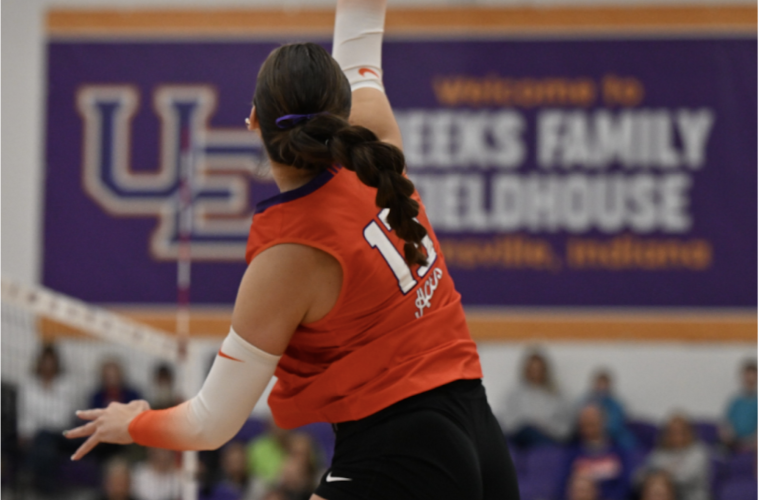
You’re in the fifth set. It’s 15-14, and you are one point away from ending the match. Your heart pounds against your chest. Your legs are heavy from yesterday’s game and a week of relentless training.
The stadium falls silent.
For a moment everything slows; the pass, the set, the swing. The rally stretches longer than usual. The ball comes flying back to your side. Your coach is shouting, teammates on their feet. The only message is to finish.
You take one more approach, one more jump, one more swing.
The ball drops to the floor.
The game is over.
The crowd goes wild and your team rushes to the court. You finally exhale only to feel the soreness set in, sharper now that the adrenaline is gone. That winning feeling is short-lived.
A volleyball player taking a swing in a match.
For many student-athletes this is the reality behind the performance of a game. A culture that celebrates “toughness”. Hidden behind the visible triumph are physical exhaustion and emotional strain, inflamed by the unspoken expectation to keep going no matter how your body or mind feels.
When signing up to be a collegiate athlete, it is easy to overlook the physical and emotional distress that quietly becomes part of the job description. As a fresher you arrive feeling like you have something to prove; that you deserve to be there, all while trying to find yourself within a new environment. As a fresher, you are expected to push through all of the mental, emotional, and physical obstacles that you encounter and that push never stops until you are officially done with your sport(s).
For some, reporting their struggles risks opportunities to compete as well as the trust of their team that they worked so hard to earn. They may feel like they are being looked upon as weak, or end up feeding the insecurity of not being good enough to be there at all. Because of this, athletes hesitate to approach their coaches to ask a question or reconsider whether they should be honest about how they are actually doing. Over time, this mindset becomes automatic.
“For the first two years of my collegiate athlete experience, my coach wouldn’t respond kindly to questions or concerns that I had. I ended up struggling to go up to them asking for feedback on what I can do better or what I should do differently. I would have panic attacks before going into their office because of how scared I was” (anonymous).
The mental, emotional, and physical distress is real, and unfortunately normalised in collegiate athletics. National research reflects this experience. A 2021 NCAA Student-Athlete Well-Being Survey found that many athletes reported feeling mentally exhausted, overwhelmed, and unable to balance sport with other demands, highlighting how performance pressures often outpace recovery and support structures¹.
Playing through injury and emotional exhaustion happens more often than most people realise. The fear of falling behind can discourage athletes to be honest with trainers and seek rest. In competitive environments where positions are never guaranteed, a short break or a missed practice can feel like a big risk. A teammate can step into your role and prove that they can do the job just as well or better than you can. This fear is the main reason for many decisions that student-athletes need to make throughout their college careers. An athlete explained, “Coming back from an injury, my teammates would start to make fun of me for taking more time off to make sure I was fully ready. Instead of taking more time off, I went back before I was fully ready and injured myself even more” (anonymous). Another anonymous athlete shared, “I kept running on a stress fracture for four days before going to the athletic trainer, all because of the pressure forcing me to keep going.”
Instead of stopping to recover, athletes often convince themselves that their injury is not serious enough, or the exhaustion is just part of “the grind”. What starts as pushing through discomfort, can deteriorate to constant strain. To accompany this article, a survey was distributed to several student athletes at different universities, with a sample size of 45 athletes. From this survey, approximately 91% of respondents report high personal expectations for themselves being the primary factor driving them to continue even whilst injured, while 43% say they fear losing playing time when reporting an injury. Practices, games, travel, and schoolwork all accumulate, leaving little time to physically, emotionally, and mentally reset. “I was the only setter on my club team so there were times I was extremely exhausted or sometimes sick but I had to play and push through. Otherwise my team wouldn’t have a setter” (anonymous).
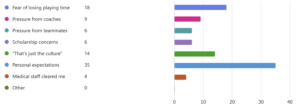
Personal expectations were the most abundantly reported factor driving athletes to push through challenges, followed by fear of losing playing time and cultural norms, while external pressures were cited less often.
Over time, the constant pushing through injuries leads to more than physical wear and tear. Student-athletes may feel burnt out from a sport they once loved so dearly. “I was lacking motivation and consistently dreading practice. I had to push through to stay in shape, headed into our championship season” (anonymous). The expectation to always be ready can make exhaustion feel normal, rather than a sign that something needs to change for the better.
Mental and emotional health is a growing consideration in collegiate athletics. Resources to support athletes are available, yet many student-athletes struggle to use these services due to limited time, difficulty of access, and lack of trust. As NCAA Champion Magazine notes, many athletes hesitate to seek help because they fear appearing weak, losing their role, or being judged within the competitive culture of college sports².
Between early morning practices, lift, classes, treatment, travel, and games, there isn’t much space in athletes’ schedules to step away and seek help, even if it is needed.
Many schools promote wellness for these athletes and encourage them to ‘take care of themselves’, but athletes often ask the question: “when would I have time?” When every minute of your day is structured around a sport, taking time for mental health can feel like falling behind rather than wellbeing. From the conducted survey, approximately 40% of respondents reported that they don’t have the time to get the help that they need, and 17% are answered ‘other’ meaning they are scared to get help and they end up trying to fix it themselves. Others worry about who will know if they asked for help, or whether being honest about stress or anxiety could change how they are being viewed by their team or coaches. The result of getting help is a disconnect between what is being offered and what is actually used. Support systems that are present are not always reachable when athletes need them most.
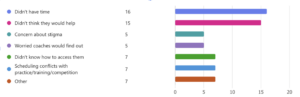
Lack of time and doubts about effectiveness were the leading barriers to student-athletes seeking support, with accessibility, scheduling issues, and stigma reported less frequently.
Suppressing struggle has long-term psychological costs. Burnout, anxiety, depression, and identity loss are all consequences that can build over time, and often go unnoticed. When athletes are constantly expected to appear strong, they learn soon enough to disconnect from what they are actually feeling³.
Pushing through becomes automatic, but so does emotional exhaustion. The sport that once brought excitement can start to feel like an obligation instead of something they love.
Over time, many athletes begin to tie their entire sense of self to how they perform. When performance drops — because of injuries, fatigue, or mental strain — it can feel like losing not just a role on the team, but a part of who they are. Without the space to acknowledge struggle, athletes are left managing the pressure on their own, carrying the weight of expectation long after the final whistle. One athlete described this shift:
“I have played my sport for almost 12 years now. Ever since I started, I have loved the game. After a couple seasons in college, I started to get burnt out. While I still love my sport, I also started hating it, and I’m still struggling with it now. I dread going to practice, even though it used to be my escape from anxiety. I hate feeling like this, but I don’t know how to get help” (anonymous).
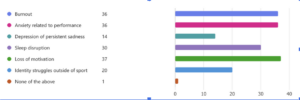
Loss of motivation, burnout, and performance anxiety were the most commonly reported challenges, with sleep disruption and identity struggles also affecting many athletes.
Conversation around college athletics has begun to shift. The current expectation asks athletes to prove their strength by ignoring pain, staying silent, and pushing past their limits, while it leaves little room for the real wellbeing of the athlete. The ability to perform should not be a consequence of physical health or personal identity. Strength could be redefined as recognising when to recover, when to speak up, and when to prioritise wellbeing over short-term performance.
Some organisations are already starting to move in that direction. Programmes from UK Sport and the English Institute of Sport focus on supporting athletes beyond physical performance by providing mental health education and access to professionals when athletes need help. Campaigns like State of Mind Sport and the Mental Health Charter for Sport and Recreation also work to reduce stigma and encourage more open conversations across sport. Efforts like these reflect a growing understanding that athletes are more than just performers.
Toughness is not merely the ability to play through an injury or exhaustion; toughness is making it possible for athletes to put their best efforts on the court. Means to do so include but are not limited to developing schedules that allow recovery, encouraging conversations about mental health, and valuing athletes as people first and performers second. The final score may show who won the match, but it does not show the cost it took to get there. Redefining what strength means could be the first step to ensure that cost is no longer invisible.
Edited by Samiya Dash
Copy-edited by Cameron McKeddie
References
1. Burnsed, B. (2021, Fall). College athletes and mental health: The hidden struggle. NCAA Champion Magazine. https://www.ncaa.org/champion/college-athletes-and-mental-health-hidden-struggle
2. Eritchie. (2020, March 10). Under pressure: Athletes and Mental Health. Family Services. https://www.familyservicesnew.org/news/under-pressure-athletes-and-mental-health/#:~:text=Amy:%20%E2%80%9CThere%20is%20a%20lot,well%20as%20their%20overall%20performance.%E2%80%9D
3. NCAA Sport Science Institute. (2022). Mental health survey of student-athletes: Fall 2021 summary report. National Collegiate Athletic Association. https://ncaaorg.s3.amazonaws.com/research/other/2020/2022RES_NCAA-SA-Well-BeingSurvey PPT.pdf